DIY electronics
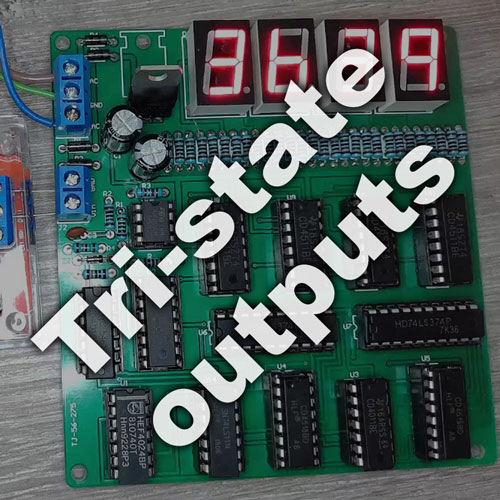
How does binary logic work? Latch registers with tri-state outputs
Latch registers built from D flip-flops freeze changing data for display or processing. A DIY frequency counter uses CD4518 counters and two 74HC374 8-bit latches with tri-state outputs to hold the measured count while counters reset. Mains-derived full-wave reference pulses drive a CD4024 divider and logic gating for 100 Hz (or 120 Hz) timing. Tri-state outputs, let the latch bus go high impedance.
Continue reading →
Building a custom electric guitar from a DIY kit
Building a custom electric guitar from a DIY kit involves using a Harley-Benton kit with quality components. The process includes decoupage techniques using rice paper and lacquer for a unique finish. Conductive graphite paint is made for shielding, and strategic assembly of parts like the neck and pick-guard is crucial. Shielding with copper foil is debated for tone impact, but enhances performance. The final product is a functional and visually appealing instrument.
Continue reading →
Matrix Connection: Few Pins, Many Options
Multiplexing techniques allow a microcontroller with limited pins to control many outputs by using decoders, demultiplexers, or shift registers. Matrix arrangements of LEDs or relays multiply output options, with persistence of vision helping simulate simultaneous activation. Designs like electronic timers and RGB running lights utilize these methods efficiently.
Continue reading →
Counting pulses and seconds without MCU
Two stopwatches use CD4518/CD40192 counters, NE555 timers, and logic gates for forward/backward counting. They demonstrate setting time, pausing, and resetting without microcontrollers.
Continue reading →
How to make a PCB
Want to build your own custom circuit board? This hands-on guide shows an easy, step-by-step approach for designing and transferring layouts, prepping a fiberglass blank, and etching a single-sided PCB. Using KiCad 7.0 and everyday items like an iron, you’ll learn tips for printing, drilling, and finishing your project with solder paste. Get pro-quality results on a DIY budget—start making PCBs today!
Continue reading →
The amazing secrets of Krank Distortus Maximus
The Krank Distortus Maximus pedal uses a single LM386N3 chip and minimal components to emulate high-gain, tube-like tones of Krank Amplifiers. Its simple yet sophisticated circuit showcases clever engineering in guitar effects design.
Continue reading →
Brown Sound in a Box
Eddie Van Halen's "Brown Sound": tracing guitar evolution from jazz to solid-body guitars. Highlights his Frankenstrat Superstrat, unique amp and effects setup, and building a pedal to emulate his tone—imperfections add character.
Continue reading →
Old School Digital Frequency Counter
Build a digital frequency counter without a microcontroller. Convert waveforms to pulses via diodes. Use an MC14553B counter and CD4017 sequencer. Measure frequency by counting pulses over one second.
Continue reading →
Why there are so many diverse Tube Screamers?
Maxon's OD808 (1979), developed by Susumu Tamura, became the Ibanez TS808 Tube Screamer, based on the BOSS OD-1 with a tone control added. It inspired many overdrive pedals that enhance amp overdrive by emphasizing certain frequencies.
Continue reading →
A simple DIY guitar tremolo pedal
How to build a simple DIY guitar tremolo pedal using three transistors? Electronic tremolo is easy to create without altering amplifier bandwidth or signal delay. The design uses a low-frequency oscillator (LFO) and a voltage-controlled amplifier (VCA), each on one transistor. Excellent results with a simple, thoughtful design (like the Univox U65RN and EA tremolo).
Continue reading →